Never miss an opportunity to hold a baby - Mandy Wood
07th JulMandy Wood explores the life of Mary Ainsworth and her pioneering attachment research
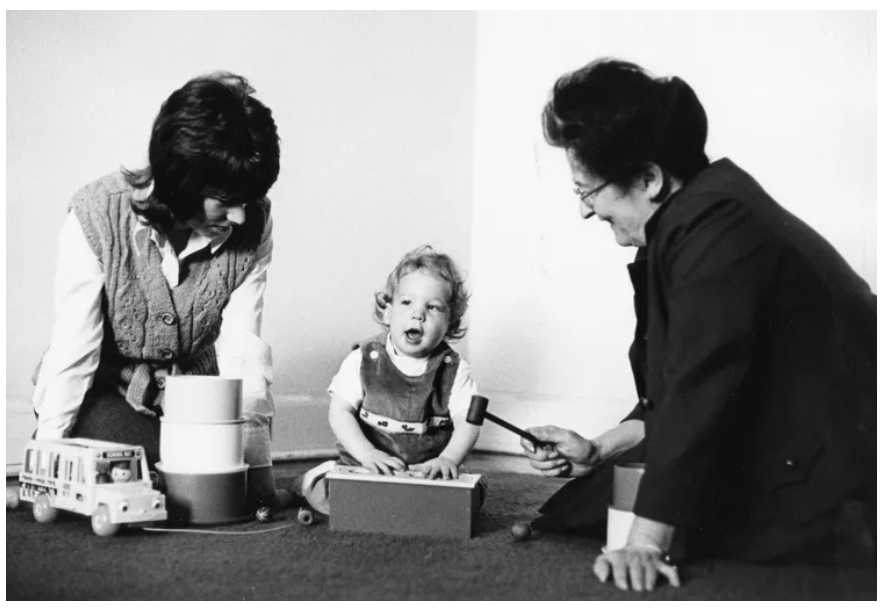
Image Credit: JHU Sheridan Libraries/Gado Archive Photos/Getty Images
Mary Ainsworth is remembered by her friends as a lover of lively parties, a competitive player of difficult board games, an avid reader of detective novels and an enthusiastic sports fan who enjoyed long and languid seaside holidays. Perhaps one of the greatest mysteries in her fun-packed life is how she ever found the time to become one of the most celebrated women in psychological history! Jokes aside, the joy Mary found in her relationships with friends, colleagues and students, as we shall discover was perhaps born of sorrow and longing in other areas of her life.
Her legacy
One of Ainsworth's greatest discoveries was the importance of parental sensitivity and responsiveness to the formation secure attachments. Another was the recognition of ‘safe-base behaviour’ as a way of identifying whether a child was securely attached or not. It was this concept that deepened her bond with John Bowlby, an early collaborator who she admitted to seeing as a surrogate father, during her time in London.
Her name is also synonymous with the development of the ‘Strange Situation’, a laboratory procedure for measuring individual differences in attachment security. However, she frequently expressed her irritation that subsequent researchers overlooked the rich insights that she believed could only be gained through naturalistic observations of everyday family routines. Instead, they seemed preoccupied with replicating her controlled observations.
Inspiration
Three-year-old Mary allegedly learned to read by studying the ‘squiggles’ in her father’s newspaper and friend Mary Main comments that this early ability to identify patterns paved the way for Ainsworth’s theoretical breakthroughs, which were inspired by meticulous observational research.
Like many others before and after her, Mary’s passion for psychology started with library book borrowed in 1928 at the age of 15. William McDougall’s “Character and the Conduct of Life” was not well accepted by mainstream scholars of the time. Freud was out, Behaviourism was in and anything that suggested that human behaviour was determined by anything other than environmental influences was largely ignored. Yet Mary was inspired. She states that it had not previously occurred to her, “that one might look within oneself for some explanation of how one felt and behaved, rather than feeling entirely at the mercy of external forces”. It was this revelation that motivated her desire to become a psychologist.
A year later, she enrolled at the University of Toronto, the city where she had lived since the age of five. As she was so young, she had to study a more general programme before beginning her degree in psychology. A year later, like many other budding young psychology students she began her studies keen “to understand how she had come to be the person she was, and what her parents had to do with it” (Bowlby and Ainsworth 1991). She quickly discovered that collecting data was both fun and fascinating and became particularly interested in personality development. In fact, in years to come she even wrote a book about the Rorschach inkblot test, a controversial measure of personality traits and emotional functioning.
Toronto seemed to be the safe base Mary needed to explore her academic interests, if not her physical environment. She stayed here for many years completing her undergraduate, masters and doctorate degrees and continuing to work at the university for several years.
Something seemed to be keeping Mary close to her own early caregivers, however, the murky depths of her unconscious remained unexplored for many years. Despite heavy criticism of Freudian theory from some of her university mentors, she received eight years of psychoanalytic therapy throughout the 1960s. She recalled her mother as jealous and disapproving of the affectionate relationship she shared with her father and was convinced that an unresolved Oedipus Complex was the source of her troubles. Despite her commitment to psychoanalytic solutions to problems in her personal life, professionally she adhered to more scientific methods.
As her academic career began to take shape, war broke out. Many of her mentors left the university, dedicating themselves to the war effort and Mary took over their teaching. Three years later, she felt the urge to become more actively involved. She joined the Canadian Women’s Army Corp (CWAC) as an army psychologist. Part of her job was to administer tests and interviews to match personnel to suitable roles. This was a great match for her skills and early academic interest in personality development. Her talents were quickly recognised and she was promoted to the rank of major within two years.
Gender discrimination
Despite success in the army, gender inequality was rife in academia at this time. Following an invitation to set up a new experimental psychology laboratory, the offer was quickly withdrawn, when the university’s governing body refused to appoint a woman. Although the outbreak of war prompted changes in gender roles and expectations, the playing field remained far from level. Women in academia were paid significantly less than men with the same qualifications and experience and were banned from certain areas. Ainsworth was pivotal in overturning both these injustices, for example, after striding into a men-only club at John Hopkins University, in Baltimore “in her best suit and rose corsage”, sitting at a centrally located table, she waited patiently until she was eventually served. From then on she regularly encouraged her female students to join her there for lunch.
Another close friend and colleague Bob Marvin described her as “a very brave woman," noting that her pioneering work “in a male-dominated university” was frequently “clobbered” but she remained resolute and unruffled. Eventually the tide began to turn - universities were required to have women representatives on all committees and Ainsworth describes a time when women academics were in high demand. She was eventually elected onto the Academic Council responsible for policy, appointments and promotions. She states that she witnessed no evidence of gender bias from this time on at John Hopkins or in her future role at the University of Virginia.
Despite a reduction in overt discrimination, the lives of Mary’s graduate class showcases the differing personal and professional experiences of men and women at this time. Her seven male classmates balanced successful careers with happy marriages and children, yet this was only true of one of the six women. Mary’s own marriage ended in divorce in 1960 and her only pregnancy ended in a miscarriage.
Grief and longing
In a letter to John Bowlby in 1984, Ainsworth explained that she felt that her loss and longing for a child of her own helped her to develop a special ability to see things from the baby’s point of view. She believed this skill allowed her to interpret the non-verbal social cues of her young participants and understand how their developing personalities were affected by their parents’ responses. Although this confession sounds unscientific, suggesting that her observations were subjective and marred by researcher bias, perhaps it should be seen as nothing more than a memory of the advice of her first mentor, William Blatz. His popular parenting books urged parents to “to unravel the child’s motives” through putting oneself in their place”.
Approaches to research
Blatz had inspired Mary’s initial interest in safe-base behaviour and encouraged her to develop a series of self-report scales to measure relations between young adults and their parents and peers. He believed that securely attached infants grow into people who feel that they belong, both at home and in the wider world, whereas insecurity in infancy leads to feelings of insignificance, helplessness and isolation. However, Mary soon began to doubt the merits of self-report as a way of studying attachment. Inspired by the work of another of Bowlby’s collaborators, James Robertson, and his work with hospitalised children, Mary turned to naturalistic observation as her preferred method and set about seeking patterns in mother-infant interactions.
At this time, she had left Toronto and travelled with her husband, Leonard, to London. She began working at the Tavistock Child Guidance Clinic in London where Bowlby was researching the effects of maternal deprivation on personality. Mary was inspired by his attitudes toward theory and research. In Toronto, she had been taught to use the hypothetico-deductive approach. Research was used to confirm hypotheses derived from pre-existing theory. For Bowlby, however, research was exploratory. His theories of attachment and deprivation slowly emerged from dozens of clinical interviews that he conducted with mothers and their children referred to the clinic.
Uganda
In 1954, the Ainsworths moved to Uganda. Leonard had been offered a job researching political attitudes toward the country’s imminent independence. Mary quickly decided to pursue her own interests while they were away. Having acquired a modest grant, she embarked upon a longitudinal naturalistic observation of 28 babies and their mothers. She recalls driving between the villages in an old Peugeot car and realising that what applied in Uganda was also true of mothers around the world; there were more similarities in attachment behaviours than differences.
Mary found the experience extremely rewarding and believed that the cultural difference between herself and her participants made it easier to be objective. She was so enthusiastic about her experiences, she later proposed that all researchers should be required to conduct cross-cultural field work as part of their training. With reference to her methodology, she also remarked that the exploratory nature of her work in Uganda was refreshing. Taking a qualitative approach had allowed her to descriptively record behaviour without being restricted by preconceived checklists, rating scales and tick boxes.
The Strange Situation
After two years, the Ainsworths left Africa and settled in Baltimore, in the United States. With memories of Uganda close at hand, she was eager to embark upon a longitudinal study of American infants. However, she struggled to attract funding. After a painful divorce, she was dealt a double blow when other academics failed to demonstrate the same enthusiasm for the findings of her research in Uganda. She was criticised for using terms such as security and anxiety when talking about such young children, and even for studying attachment, which was deemed to be too broad and abstract a term to be worthy of scientific study. However, this criticism spurred Mary to create the tightly operationalised categories that made the Strange Situation the gold standard assessment tool that it remains today.
Although sometimes criticised for lacking ecological validity, many fail to recognise that Mary had already conducted an average of 72 hours of observations in the homes of each of the 26 families that visited her laboratory at John Hopkins. She had visited them once every three weeks since the infants were less than a month old. It was these visits that encouraged her to suggest that the behaviours characteristic of insecure avoidant babies, in particular, were a defence strategy developed throughout the first year in response to insensitive parenting. Ainsworth noted that these babies in fact cried and sought attention a lot at home but their needs were often left unmet. When confronted with the additional stress of the unfamiliar environment they demonstrated behaviours similar to those described by James Robertson. Mary had been interested by his observations of children separated from their parents while staying in hospital. These children showed a pattern of protest, despair and finally detachment. Mary felt that the anxious avoidant infants her study showed similar responses, despite not experiencing physical separations, the apparent emotional separation of these mothers from their infants within their own homes was enough to leave a lasting impression on their behaviour and developing personalities.
Mary’s students
Like the mother of a securely attached infant, Mary encouraged independence in her graduate students. Many professors at this time merely prompted their students to analyse pre-existing data sets, but Mary felt that this would not help them to develop and refine their research skills and ensured that they all planned, and conducted their own studies. Former student, Bob Marvin, who also became a close friend, described her as “like a mother” and in fact, it was he and his wife, Cheri, that cared for Ainsworth in her old age, just before she died, aged 85. In an interview with Marvin, she once stated that one should “never miss an opportunity to hold a baby”. Her advice conflicted with the norms of the time, that picking up a crying baby would reinforce their crying and make them clingier. However, together with Bowlby, Ainsworth revolutionised modern trends in parenting with the recognition that ‘we are all only as needy as our unmet needs’.
Discussion Points
- During the 1960s, men and women were not allowed to mix informally at lunchtime and were restricted to separate dining areas. What impact do you think this had on their research and their careers?
- Mary Ainsworth was Canadian and had no children of her own; do you think it is important to know these details when considering the credibility of her observations of mother-infant interactions in Uganda?
Join a highly respected national and international community of psychology teachers with opportunities to network and collaborate.
FIND OUT MORE